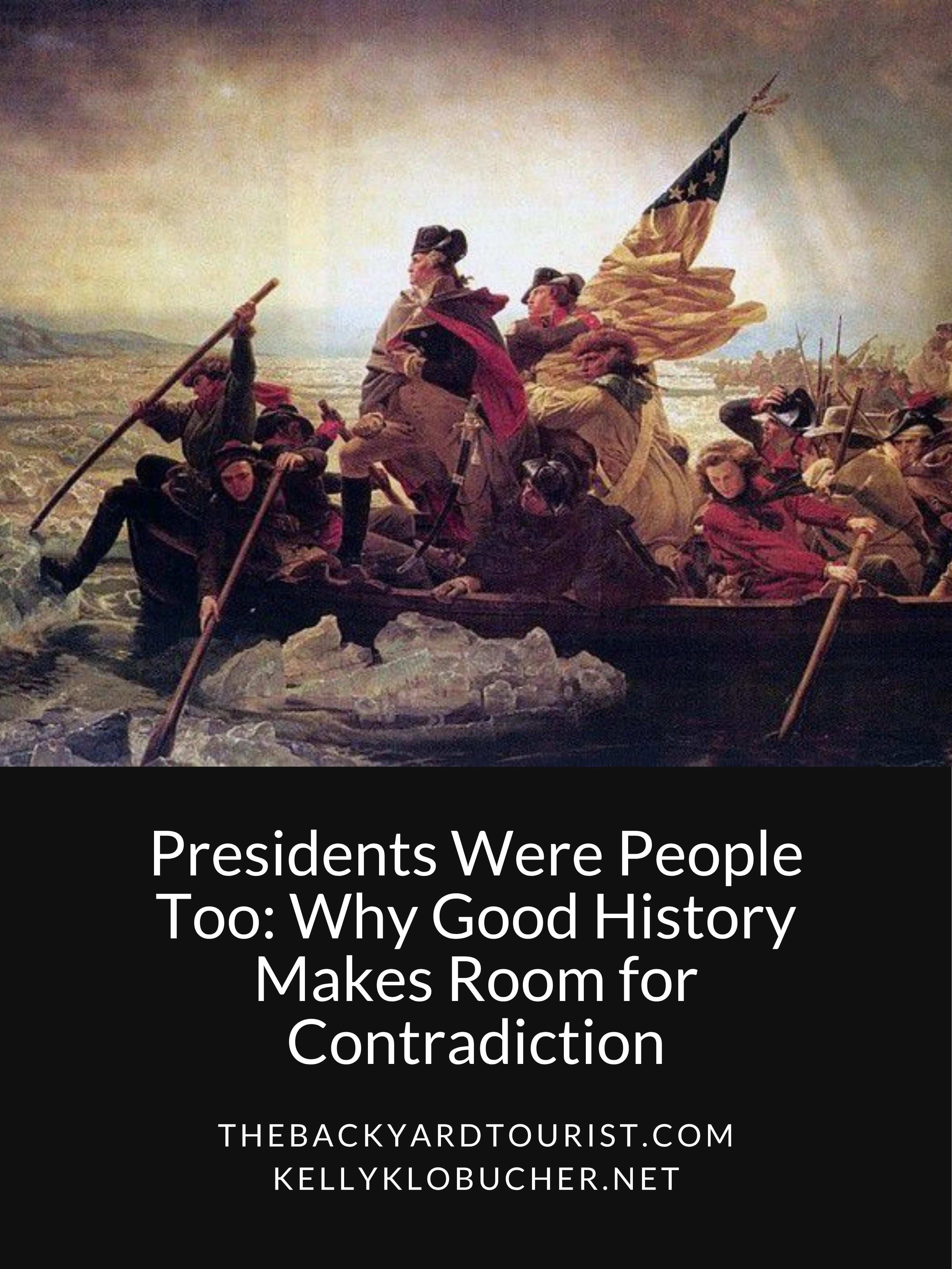
We have a strange relationship with our heroes.
We put them on pedestals, name streets and schools after them, build statues in their likeness, and teach generations of children about the moment when they were brave, brilliant, victorious, or consequential.
And then, eventually, we discover that they were human.
They owned slaves. They cheated on their spouses. They drank too much. They made terrible decisions. They held prejudices that were common in their time—or sometimes prejudices that were distinctly their own. They treated people badly. They pursued power. They made mistakes.
And suddenly, we want to tear them down.
Perhaps we need to stop doing both.
Good historians don’t turn people into heroes. But they don’t turn them into villains, either.
They tell us who people were.
That is considerably more complicated.
No One Is Heroic Every Day
Think about almost anyone who has become famous because of something they accomplished.
A president may have led the country through a crisis.
A general may have won a crucial battle.
An athlete may have performed one extraordinary feat.
An activist may have changed the law.
An explorer may have crossed a continent.
A scientist may have made a discovery that changed the world.
That achievement is real.
But it is only one part of a life.
The problem begins when we take the extraordinary moment and use it to explain the entire person.
We call someone a war hero and begin to imagine that courage defined every aspect of his character.
In my career outside of history, I was fortunate to meet and befriend several people from the greatest generation who behaved heroically in WWII, as well as baby boomers who served in Korea and Vietnam-and were treated VERY differently after returning home from service.
We call someone a great president and unconsciously begin to assume that greatness extended to everything he did.
We call an athlete a legend and forget that being extraordinary on a playing field doesn’t make someone extraordinary in every other area of life.
History doesn’t work that way.
People aren’t monuments.
They are collections of contradictions.
The Founders Were Not Living Statues
American history provides perhaps the most obvious examples.
The men who helped create the United States articulated extraordinary ideas about liberty and government.
The Declaration of Independence famously proclaimed that “all men are created equal” and that people possess fundamental rights.
Those ideas became enormously influential.
But many of the people who articulated them also lived within a society built upon slavery.
Thomas Jefferson drafted the Declaration while enslaving people. George Washington, another central figure in the founding of the United States, also enslaved people.
Those facts don’t make the Declaration’s ideals meaningless.
Nor do the ideals make slavery disappear.
Both things are historically true.
And that contradiction is actually more interesting than the simplified version.
The founding generation could articulate a revolutionary philosophy of human liberty while participating in—or benefiting from—a system that denied liberty to millions of people.
That isn’t a problem historians need to solve.
It’s a contradiction historians need to explain.
Expansion Has More Than One Story
The same problem appears when we talk about American expansion.
For generations, American history was often presented as a story of progress: settlers moved west, territories became states, railroads connected the continent, and the United States grew into a continental nation.
That story contains enormous historical change.
But it isn’t the whole story.
Expansion came at an enormous cost to Indigenous nations and communities.
The Library of Congress documents how U.S. expansion and government policies resulted in Native communities being displaced, dispersed, and, in some cases, destroyed. Especially once the budget for moving people proved to be more expensive than elimination.
The Indian Removal Act of 1830 authorized the removal of Native people from lands within existing state boundaries. The forced removal of the Cherokee became the Trail of Tears, during which approximately 4,000 Cherokee people died.
So what do we do with figures associated with American expansion?
We don’t have to pretend they accomplished nothing.
And we don’t have to pretend the consequences of their policies were insignificant.
We can ask better questions.
What did they accomplish?
Who benefited?
Who paid the price?
What choices did they make?
What alternatives existed?
What did they believe?
What did they understand about the consequences of their actions?
And perhaps most importantly:
Whose perspective has been left out of the traditional story?
That is history.
Context Isn’t an Excuse
There is an important distinction between explaining someone’s behavior and excusing it.
Historians need context.
We need to understand what people believed, what choices were available to them, what laws existed, what their society valued, and what they could reasonably have known.
But context shouldn’t become an escape hatch.
“Everyone did it” isn’t necessarily an adequate historical explanation.
Neither is “That’s just how things were.”
Sometimes people challenged the conventions of their own time.
Sometimes they benefited from them.
Sometimes they did both.
Human beings are capable of recognizing injustice in one part of their lives while participating in injustice somewhere else.
That uncomfortable reality is precisely why history is worth studying.
We Are Very Good at Turning People Into Symbols
There is a psychological comfort in simple stories.
Hero.
Villain.
Good guy.
Bad guy.
Genius.
Fool.
Patriot.
Traitor.
But real people rarely fit neatly into those categories.
Once someone becomes a symbol, however, we stop being interested in the person.
George Washington becomes The Father of His Country.
Abraham Lincoln becomes The Great Emancipator.
Andrew Jackson becomes either a champion of the common man or a symbol of Indian removal.
A famous athlete becomes an icon.
A military commander becomes a legend.
A political leader becomes a portrait on the wall.
The actual human being disappears beneath the mythology.
And mythology is remarkably difficult to argue with because it isn’t really history.
It’s memory.
And Then We Discover the Human Being
Here’s where the pendulum swings.
Once we discover that our hero wasn’t perfect, we sometimes decide the opposite must be true.
If Washington owned slaves, perhaps everything about Washington was therefore morally corrupt.
If a president pursued policies that harmed Indigenous people, perhaps nothing that president accomplished deserves recognition.
If a famous athlete behaved terribly away from the field, perhaps his athletic achievements should no longer matter.
If a historical figure held racist or sexist beliefs, perhaps we should erase everything else about their life.
This is another form of simplification.
We haven’t stopped mythologizing the person. We’ve simply reversed the mythology.
The hero has become the villain.
The pedestal has become the dunk tank.
But the historical figure remains hidden.
Historians Should Resist the Pedestal
One of the great responsibilities of historians, museums, historic sites, and public historians is to resist that temptation.
The Smithsonian’s American Experience materials, for example, explicitly present historical figures such as Andrew Jackson and Tecumseh through the complicated ways their actions shaped their legacies “for better or worse.”
That is a much more useful approach.
Instead of asking:
“Was this person good or bad?”
Ask:
“What did this person do?”
Then:
“Why did they do it?”
Then:
“Who was affected?”
And finally:
“How should we understand those actions today?”
Those questions allow us to preserve complexity.
A Museum Doesn’t Have to Choose Between Celebration and Condemnation
This matters enormously in museums.
Visitors don’t necessarily need us to tell them what to think.
They need us to give them enough information to think.
Imagine a historic house belonging to a prominent American.
You could present the person as a brilliant statesman, decorated military leader, successful businessman, or influential citizen.
Or you could focus exclusively on their failures.
But a more compelling exhibition might do something harder:
Tell the whole story.
Show the achievements.
Show the contradictions.
Show the people who benefited.
Show the people who were harmed.
Show what the person believed.
Show what they wrote.
Show what they did.
Show what happened afterward.
Let visitors sit with the uncomfortable gap between ideals and actions.
That gap is often where the best history lives.
We Don’t Have to Forgive Historical Figures
There is another important distinction.
Understanding someone doesn’t mean forgiving them.
We can recognize that a person accomplished something extraordinary while also acknowledging that they caused harm.
We can admire a political achievement without endorsing every policy associated with the person who achieved it.
We can appreciate a military victory without pretending that war is uncomplicated.
We can acknowledge a president’s accomplishments while confronting the people who suffered because of his decisions.
We can appreciate an athlete’s extraordinary talent without confusing athletic greatness with personal virtue.
Historical significance is not the same thing as moral perfection.
And perhaps that’s the lesson we should teach more often.
The Problem With Expecting Heroes to Be Perfect
Maybe part of our fascination with tearing down heroes comes from an impossible expectation.
We want historical figures to be better than we are.
Braver.
Smarter.
More principled.
More courageous.
More consistent.
We want them to have known the right answer every time.
But they didn’t.
They were people making decisions with incomplete information, personal ambitions, prejudices, fears, relationships, egos, pressures, and competing interests.
Just like us.
That doesn’t make their accomplishments less significant.
It makes their lives more understandable.
And sometimes, more instructive.
The heroes I’ve been fortunate to meet in person could tell one hell of a story about serving in the US First Division in WWII in Germany, Purple Heart, Bronze Star, but he also adored his beautiful wife of almost 80 years, and made the best dirty martini I’ve ever had. All of these things can be true. Hero. Husband. Father. Businessman. Community leader. Retiree. Martini maker.
It takes a lifetime to make history.
History Is Not a Courtroom
The historian’s job isn’t necessarily to put every dead person on trial.
Nor is it to defend them. (Though we may want to, when working in their intimate environments, studying their diaries and letters, and getting to know the humanity behind the hero.)
It is to investigate.
To gather evidence.
To establish what happened.
To understand context.
To recognize consequences.
To acknowledge uncertainty.
And to resist the urge to make the story cleaner than it really was.
The past doesn’t need us to make its people perfect.
It also doesn’t need us to make them monsters.
It needs us to let them be human.
The Most Interesting People Are Usually Complicated
The people who changed history rarely lived simple lives.
They could be courageous in one moment and cowardly in another.
Generous toward one person and cruel toward another.
Visionary in one area and profoundly blind in another.
They could fight for freedom while denying it to others.
They could expand a nation while destroying communities.
They could achieve something extraordinary and still make terrible personal choices.
None of those contradictions cancel the others.
They coexist.
And that’s what makes history fascinating.
Maybe We Should Stop Asking, “Was He a Hero?”
Instead, let’s ask better questions.
What did he accomplish?
What did she believe?
Who benefited?
Who suffered?
What choices did they make?
What alternatives existed?
What did they get right?
What did they get terribly wrong?
How did people at the time understand their actions?
How do we understand them now?
And perhaps the most important question:
What can we learn from the contradiction?
Because the goal of history isn’t to create better statues.
It’s to create better understanding.
No One Is a Hero Every Day
There is a tendency to believe that if we acknowledge the flaws of our heroes, we somehow diminish their accomplishments.
I think the opposite is true.
A person who accomplished something remarkable despite being imperfect is more interesting than a marble statue who never made a mistake.
The soldier can be brave and flawed.
The president can be consequential and wrong.
The founder can articulate liberty and participate in slavery.
The general can win battles and make disastrous decisions.
The athlete can be extraordinary on the field and deeply ordinary—or deeply flawed—off it.
None of that requires us to erase the achievements.
It requires us to stop pretending that achievement makes someone perfect.
No one is heroic every day.
And perhaps that is the most important thing history can teach us.
Our heroes were people.
They were complicated.
They contradicted themselves.
They made choices.
They changed.
They failed.
They succeeded.
And sometimes they did something extraordinary.
Our job isn’t to put them on a pedestal.
Our job is to understand why.
That is a much more honest way to remember the past.
And, perhaps, a much more useful way to understand ourselves.


Leave a Reply